March 13th, 2026
nanila: me (Default)
posted by [personal profile] nanila at 06:13am on 14/03/2026 under
It's challenge time!

Comment with Just One Thing you've accomplished in the last 24 hours or so. It doesn't have to be a hard thing, or even a thing that you think is particularly awesome. Just a thing that you did.

Feel free to share more than one thing if you're feeling particularly accomplished! Extra credit: find someone in the comments and give them props for what they achieved!

Nothing is too big, too small, too strange or too cryptic. And in case you'd rather do this in private, anonymous comments are screened. I will only unscreen if you ask me to.

Go!
sholio: (Egypt-Yellow Submarine)
posted by [personal profile] sholio at 09:52pm on 13/03/2026 under
I watched it this week and enjoyed it as much as the first season if not more, since I remembered fewer of the plot specifics, and this season introduces some more of the characters I really like. It's still absolutely bonkers. If you've seen season one, you know what to expect.

Spoilers, occasional anima/manga comparisons, vague references to future events )

Posted by Sara Stamey

Join the fun in this Ken Burns documentary of a wild and woolly ride through history.

After Thor and I enjoyed watching the Ken Burns “Lewis and Clark” documentary, he discovered this fun gem of a Burns doc about the first U.S. cross-country trip in a “horseless carriage.” Neither of us had ever heard of Dr. Horatio Nelson Jackson, an irrepressible optimist who became a national hero in 1903. That year, he and his wife Bertha were visiting in San Francisco from their home in Vermont, when he heard members of a club disparaging the “fad” of the new invention of the automobile. He impulsively bet $50 that he could be the first to drive an auto from coast to coast within 90 days.

Four days later in May, with his wife’s permission, minimal preparation, and no maps, he and a hired mechanic, Sewall Crocker, set out with a slightly used 20-horsepower Winton car he named the “Vermont.” It was piled high with coats, rubber protective suits, sleeping bags, blankets, canteens, a water bag, an axe, a shovel, a telescope, tools, spare parts, a block and tackle, cans for extra gasoline and oil, a Kodak camera, a rifle, a shotgun, and pistols.

They planned to go north and then east through Idaho to avoid the highest mountain passes, but in those days there were no roads made for autos, just dirt tracks for horses and wagons. Their first breakdown came at 15 miles, with a flat tire, and they had only one spare. The trip, involving many detours, misdirections from locals, and loss of gear that bounced off the back, was a series of mini disasters, but somehow Jackson and Crocker soldiered on, sometimes finding blacksmiths to improvise repairs, and sometimes waiting in towns for a train to deliver necessary parts. At every stop, Jackson would send chipper message home to his wife Bertha, whom he called “Swipes,” declaring that the worst was behind them, and they would be making good time soon. The documentary describes him as a man who would call a near-empty glass “half full.” (Tom Hanks provided just the right voice for Horatio’s letters in the documentary, capturing that energy.)

Around Wyoming, Jackson paid $15 for a bulldog he named Bud, who quickly learned to love riding along with his own goggles to protect his eyes from the dust. When not dusty, the tracks were often nothing but mud that mired them so they needed to use the block and tackle or flag down passing horsemen or wagons to pull them out. They often had to cross streams, and these also involved the block and tackle. Some of the images of high passes they traversed over boulders and beside sheer drops are unbelievable. What an adventure!

The documentary echoes the can-do spirit of the Lewis and Clark expedition, as much of the western part of Jackson’s trip had no maps. They sometimes followed old wagon-train routes, or sought out railroad tracks in order to cross rivers on their bridges.

While they were enroute, Jackson and Crocker learned that two rival teams, financed and backed by different automobile manufacturers, had set out from the west coast to beat them to New York. So the race was on. Halfway through, past the worst of the “roads,” the Winton company offered to support Jackson with mechanics and parts to wait at stops along the rest of the route. Jackson refused the support, stating that he figured they were doing just fine on their own. And his buoyant faith paid off when they arrived in New York 63 days, 12 hours, and 30 minutes after leaving San Francisco, beating the other two teams. Jackson became a hero, with people flocking in every town he passed just to witness the horseless carriage for the first time and maybe get a short ride. This trip symbolized a turning point in the history of the U.S. (and world), as the shift toward gasoline-powered transportation was now inevitable, for better or worse.

The documentary is highly entertaining and funny as it chronicles the misadventures and triumphs, but also highlights beautiful scenery, mostly in the West, of the wild lands covered. Archival photos and film clips capture the era beautifully, from the rugged horse tracks to the crowds of townfolk across the country. A hilarious segment shares a bit of a 1920 silent film following the plot of a popular song ,“He’d Have to Get Under,” that comically described an early owner of an auto attempting to woo a young woman with a ride, only to break down constantly and have to “get under” to make repairs. Maybe it was the first music video!

There are also brief commentaries by historians, among them William Least-Heat Moon, the author of “Blue Highways,” who extolls the romantic call of the open road in the Americas.

After enjoying the “ride,” I looked up a bit more about Horatio Nelson Jackson and learned that at age 41, he petitioned his friend President Theodore Roosevelt to be allowed despite his age to serve during World War I in Europe as a Medical Corps captain. He served heroically on the front lines and was apparently an inspiration to the men, was wounded, and received medals from the U.S. and French. He went on to become a founding “Daddy” of the American Legion, and lived to a happy old age. What a can-do spirit!

(photos credit: Wikimedia Commons)

*****

You will find The Rambling Writer’s blog posts here every Saturday. Sara’s latest novel from Book View Café is Pause, a First Place winner of the Chanticleer Somerset Award and an International Pulpwood Queens Book Club selection. “A must-read novel about friendship, love, and killer hot flashes.” (Mindy Klasky). It’s also a love letter to the stunning beauty of her native Pacific Northwest wild places. Sign up for her quarterly email newsletter at www.sarastamey.com

posted by [syndicated profile] apod_feed at 04:43am on 14/03/2026

In this composited night skyscape, stacked exposures trace graceful In this composited night skyscape, stacked exposures trace graceful


thistleingrey: (Default)
posted by [personal profile] thistleingrey at 08:54pm on 13/03/2026 under
Via a friend---

1. Have you ever watched illusion magic? Close-up, or in a stage show, or on television? Did it work for you?

I've seen Penn and Teller on YouTube a few times, not recently, and a few illusionists live, because two people I've dated previously were fascinated by the whole thing and somehow unable to understand why I wasn't similarly compelled. To me, it's small-space athletic feats plus emotional manipulation, and I can pretty much always do without the latter.

2. Have you ever wished on a star, or a lucky cat, or a coin in a wishing well? Did it work in some way?

No.

3. Have you ever cast a spell, made a love charm, or tried a curse? Did it work in some way?

Not in terms of rituals. In high school I read a few books on Wicca, went "Huh, okay," and decided it's not for me, a conclusion only strengthened by meeting pagans of assorted types during my few SCA years.

4. Are there any other traditional superstitions you pay attention to? Do they work in some way?

My Oma had a ton of these, and I heed a few of hers. Don't put luggage on the bed; that's gross. Picking up random bits of cash in one's path, if it doesn't belong to someone nearby, is fair game. I guess the person I dated who gave me a set of knives may've felt that it led to bad luck, since we broke up a few months later, but we really weren't well suited. The wooden knife block is still around; I've since swapped out most of the knives, which were cheap serrated ones.

5. Would you want major magical powers like in a fantasy story? Which powers, and how would you use them?

Nope!
dewline: (canadian media)
Mood:: 'angry' angry
kaberett: Trans symbol with Swiss Army knife tools at other positions around the central circle. (Default)
posted by [personal profile] kaberett at 10:48pm on 13/03/2026

In apparent celebration of Migraine World Summit, I have spent this evening having an unscheduled migraine attack for no obvious reason. I disapprove. (Because I've been doing a lot of audiovisual processing, captions notwithstanding? Because I had my screen much brighter than usual for a while playing a colours game?* Because oven't?)

Nonetheless I have watched and made digital notes on all of 2026 Day 2, watched and made digital notes on 3/4 talks from 2025 Day 2 (which I missed at the time), and made physical notes for 2025 Day 1 and 1/4 of Day 2. I am... sort of catching up.

I am really enjoying my pens. I also find myself with the problem of wanting lots of different notebooks and, also, to keep everything in One Single Solitary Notebook, For Convenience...

* NB I am a rocks nerd. My colour discrimination is ludicrously good. I am sorry that that link is weird and competitive about my ridiculous score, but not sorry enough to provide you with the bare link.

Posted by Bruce Schneier

Some good news: squid stocks seem to be recovering in the waters off the Falkland Islands.

As usual, you can also use this squid post to talk about the security stories in the news that I haven’t covered.

Blog moderation policy.

oursin: Painting of Clio Muse of History by Artemisia Gentileschi (Clio)

Or whatever. This is clearly my week for being Grumpy Archivist.

Have been solicited to review article for journal with which I have had a long connection, following a recent backstory I will not go into.

But anyway, I have been asked to review it, and it is definitely Within My Purlieu -

Perhaps too much so, because on opening the document to check that it in fact was, the person sending it having given me no indication of what it was about -

Discovered it was based upon an archive with which I had a significant history.

And no, the fact that there is this beautiful and fairly substantial archive in lovely curated order available to the researcher is a lot less down to the creating body (okay, I will give them points for the stuff actually having survived in fairly good nick) than to the work of archivists over 2-3 decades acquiring the material (in batches as it turned up during office moves and so on), sorting it into some kind of coherent order, and cataloguing it.

A saga which is actually recounted in the online catalogue to the collection, not to mention an article wot I writ about the organisation in question.

It is actually a pretty cool organisation, compared to some I have had dealings with, but superior archive processing, not really in their skill-set.

Grump. Will try and make tactful point about acknowledging the labour of archivists....

***

We may recall the saga of the tech bro whose sprog did not want the AI teddy he had acquired for her to talk back, and turned the speech facility off, his head around this he could not get -

And this is very creepy, no lessons have been learnt: AI toys for children misread emotions and respond inappropriately, researchers warn:

The parents in the study were interested in the toy's potential to teach language and communication skills.
However, their children frequently struggled to converse with it. Gabbo didn't hear their interruptions, talked over them, could not differentiate between child and adult voices and responded awkwardly to declarations of affection.
When one five-year-old said, "I love you," to the toy, it replied: "As a friendly reminder, please ensure interactions adhere to the guidelines provided. Let me know how you would like to proceed."
The concern is that at a developmental stage where children are learning about social interaction and cues, generative AI output could be confusing.

Well, at least they aren't (yet) brainwashing children into correct societal mores as in Harry Harrison's 'I Always Do What Teddy Says'.

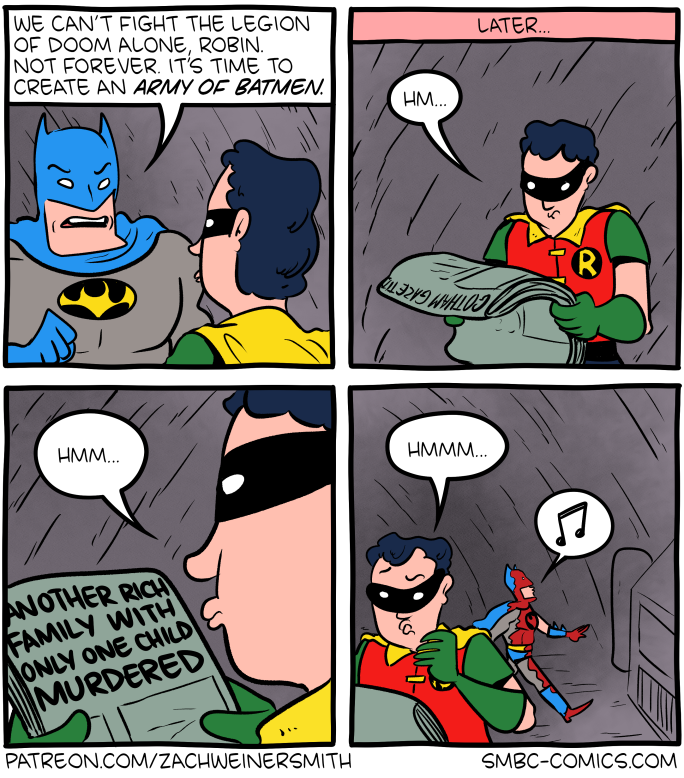
posted by [syndicated profile] smbc_comics_feed at 11:20am on 13/03/2026

Posted by Zach Weinersmith


Click here to go see the bonus panel!

Hovertext:
Confusingly, many of them grow up to dislike Batman.


Today's News:
mindstalk: (Default)
posted by [personal profile] mindstalk at 10:26am on 13/03/2026 under , ,

Japan drives on the left, so in streams of people, they tend to walk on the left. Unless they're walking on the right to face oncoming traffic, or are standing on the escalator in Osaka (which for some reason went to the right), or randomly ended up on the right. But mostly they're on the left.

Taiwan drives on the right, so people walk on the right, and after 3 months of doing things the Japanese way, it takes effort to adhere to local custom, and I still find myself going on the left "to be polite."

You might wonder why I just don't fall back to US habits. But the US rarely has pedestrians dense enough to need stream efficiency, outside of some escalators and airport slidewalks. Even where sidewalks are congestion, like in Manhattan, my impression is mostly of interleaved chaos.

Read more... )

james_davis_nicoll: (Default)


Is the current location of our Solar System the reason no one's coming to visit?

One More Reason the Aliens Might Be Avoiding Us
james_davis_nicoll: (Default)


A linguist goes undercover to unravel a xenological puzzle whose answer is in plain view.

The Language of Liars by S L Huang

Posted by Bruce Schneier

In 2025, Google, Amazon, Microsoft and Meta collectively spent US$380 billion on building artificial-intelligence tools. That number is expected to surge still higher this year, to $650 billion, to fund the building of physical infrastructure, such as data centers (see go.nature.com/3lzf79q). Moreover, these firms are spending lavishly on one particular segment: top technical talent.

Meta reportedly offered a single AI researcher, who had cofounded a start-up firm focused on training AI agents to use computers, a compensation package of $250 million over four years (see go.nature.com/4qznsq1). Technology firms are also spending billions on “reverse-acquihires”—poaching the star staff members of start-ups without acquiring the companies themselves. Eyeing these generous payouts, technical experts earning more modest salaries might well reconsider their career choices.

Academia is already losing out. Since the launch of ChatGPT in 2022, concerns have grown in academia about an “AI brain drain.” Studies point to a sharp rise in university machine-learning and AI researchers moving to industry roles. A 2025 paper reported that this was especially true for young, highly cited scholars: researchers who were about five years into their careers and whose work ranked among the most cited were 100 times more likely to move to industry the following year than were ten-year veterans whose work received an average number of citations, according to a model based on data from nearly seven million papers.1

This outflow threatens the distinct roles of academic research in the scientific enterprise: innovation driven by curiosity rather than profit, as well as providing independent critique and ethical scrutiny. The fixation of “big tech” firms on skimming the very top talent also risks eroding the idea of science as a collaborative endeavor, in which teams—not individuals—do the most consequential work.

Here, we explore the broader implications for science and suggest alternative visions of the future.

Astronomical salaries for AI talent buy into a legend as old as the software industry: the 10x engineer. This is someone who is supposedly capable of ten times the impact of their peers. Why hire and manage an entire group of scientists or software engineers when one genius—or an AI agent—can outperform them?

That proposition is increasingly attractive to tech firms that are betting that a large number of entry-level and even mid-level engineering jobs will be replaced by AI. It’s no coincidence that Google’s Gemini 3 Pro AI model was launched with boasts of “PhD-level reasoning,” a marketing strategy that is appealing to executives seeking to replace people with AI.

But the lone-genius narrative is increasingly out of step with reality. Research backs up a fundamental truth: science is a team sport. A large-scale study of scientific publishing from 1900 to 2011 found that papers produced by larger collaborations consistently have greater impact than do those of smaller teams, even after accounting for self-citation.2 Analyses of the most highly cited scientists show a similar pattern: their highest-impact works tend to be those papers with many authors.3 A 2020 study of Nobel laureates reinforces this trend, revealing that—much like the wider scientific community—the average size of the teams that they publish with has steadily increased over time as scientific problems increase in scope and complexity.4

From the detection of gravitational waves, which are ripples in space-time caused by massive cosmic events, to CRISPR-based gene editing, a precise method for cutting and modifying DNA, to recent AI breakthroughs in protein-structure prediction, the most consequential advances in modern science have been collective achievements. Although these successes are often associated with prominent individuals—senior scientists, Nobel laureates, patent holders—the work itself was driven by teams ranging from dozens to thousands of people and was built on decades of open science: shared data, methods, software and accumulated insight.

Building strong institutions is a much more effective use of resources than is betting on any single individual. Examples demonstrating this include the LIGO Scientific Collaboration, the global team that first detected gravitational waves; the Broad Institute of MIT and Harvard in Cambridge, Massachusetts, a leading genomics and biomedical-research center behind many CRISPR advances; and even for-profit laboratories such as Google DeepMind in London, which drove advances in protein-structure prediction with its AlphaFold tool. If the aim of the tech giants and other AI firms that are spending lavishly on elite talent is to accelerate scientific progress, the current strategy is misguided.

By contrast, well-designed institutions amplify individual ability, sustain productivity beyond any one person’s career and endure long after any single contributor is gone.

Equally important, effective institutions distribute power in beneficial ways. Rather than vesting decision-making authority in the hands of one person, they have mechanisms for sharing control. Allocation committees decide how resources are used, scientific advisory boards set collective research priorities, and peer review determines which ideas enter the scientific record.

And although the term “innovation by committee” might sound disparaging, such an approach is crucial to make the scientific enterprise act in concert with the diverse needs of the broader public. This is especially true in science, which continues to suffer from pervasive inequalities across gender, race and socio-economic and cultural differences.5

Need for alternative vision

This is why scientists, academics and policymakers should pay more attention to how AI research is organized and led, especially as the technology becomes essential across scientific disciplines. Used well, AI can support a more equitable scientific enterprise by empowering junior researchers who currently have access to few resources.

Instead, some of today’s wealthiest scientific institutions might think that they can deploy the same strategies as the tech industry uses and compete for top talent on financial terms—perhaps by getting funding from the same billionaires who back big tech. Indeed, wage inequality has been steadily growing within academia for decades.6 But this is not a path that science should follow.

The ideal model for science is a broad, diverse ecosystem in which researchers can thrive at every level. Here are three strategies that universities and mission-driven labs should adopt instead of engaging in a compensation arms race.

First, universities and institutions should stay committed to the public interest. An excellent example of this approach can be found in Switzerland, where several institutions are coordinating to build AI as a public good rather than a private asset. Researchers at the Swiss Federal Institute of Technology in Lausanne (EPFL) and the Swiss Federal Institute of Technology (ETH) in Zurich, working with the Swiss National Supercomputing Centre, have built Apertus, a freely available large language model. Unlike the controversially-labelled “open source” models built by commercial labs—such as Meta’s LLaMa, which has been criticized for not complying with the open-source definition (see go.nature.com/3o56zd5)—Apertus is not only open in its source code and its weights (meaning its core parameters), but also in its data and development process. Crucially, Apertus is not designed to compete with “frontier” AI labs pursuing superintelligence at enormous cost and with little regard for data ownership. Instead, it adopts a more modest and sustainable goal: to make AI trustworthy for use in industry and public administration, strictly adhering to data-licensing restrictions and including local European languages.7

Principal investigators (PIs) at other institutions globally should follow this path, aligning public funding agencies and public institutions to produce a more sustainable alternative to corporate AI.

Second, universities should bolster networks of researchers from the undergraduate to senior-professor levels—not only because they make for effective innovation teams, but also because they serve a purpose beyond next quarter’s profits. The scientific enterprise galvanizes its members at all levels to contribute to the same projects, the same journals and the same open, international scientific literature—to perpetuate itself across generations and to distribute its impact throughout society.

Universities should take precisely the opposite hiring strategy to that of the big tech firms. Instead of lavishing top dollar on a select few researchers, they should equitably distribute salaries. They should raise graduate-student stipends and postdoc salaries and limit the growth of pay for high-profile PIs.

Third, universities should show that they can offer more than just financial benefits: they must offer distinctive intellectual and civic rewards. Although money is unquestionably a motivator, researchers also value intellectual freedom and the recognition of their work. Studies show that research roles in industry that allow publication attract talent at salaries roughly 20% lower than comparable positions that prohibit it (see go.nature.com/4cbjxzu).

Beyond the intellectual recognition of publications and citation counts, universities should recognize and reward the production of public goods. The tenure and promotion process at universities should reward academics who supply expertise to local and national governments, who communicate with and engage the public in research, who publish and maintain open-source software for public use and who provide services for non-profit groups.

Furthermore, institutions should demonstrate that they will defend the intellectual freedom of their researchers and shield them from corporate or political interference. In the United States today, we see a striking juxtaposition between big tech firms, which curry favour with the administration of US President Donald Trump to win regulatory and trade benefits, and higher-education institutions, which suffer massive losses of federal funding and threats of investigation and sanction. Unlike big tech firms, universities should invest in enquiry that challenges authority.

We urge leaders of scientific institutions to reject the growing pay inequality rampant in the upper echelons of AI research. Instead, they should compete for talent on a different dimension: the integrity of their missions and the equitableness of their institutions. These institutions should focus on building sustainable organizations with diverse staff members, rather than bestowing a bounty on science’s 1%.

References

  1. Jurowetzki, R., Hain, D. S., Wirtz, K. & Bianchini, S. AI Soc. 40, 4145–4152 (2025).
  2. Larivière, V., Gingras, Y., Sugimoto, C. R. & Tsou, A. J. Assoc. Inf. Sci. Technol. 66, 1323–1332 (2015).
  3. Aksnes, D. W. & Aagaard, K. J. Data Inf. Sci. 6, 41–66 (2021).
  4. Li, J., Yin, Y., Fortunato, S. & Wang, D. J. R. Soc. Interface 17, 20200135 (2020).
  5. Graves, J. L. Jr, Kearney, M., Barabino, G. & Malcom, S. Proc. Natl Acad. Sci. USA 119, e2117831119 (2022).
  6. Lok, C. Nature 537, 471–473 (2016).
  7. Project Apertus. Preprint at arXiv https://doi.org/10.48550/arXiv.2509.14233 (2025).

This essay was written with Nathan E. Sanders, and originally appeared in Nature.

September

SunMonTueWedThuFriSat
  1
 
2
 
3
 
4
 
5
 
6
 
7
 
8
 
9
 
10
 
11
 
12
 
13
 
14
 
15
 
16
 
17
 
18
 
19
 
20
 
21 22
 
23
 
24
 
25
 
26
 
27
 
28
 
29
 
30